

Deep Dive: Institutional Efficiency & The Student ROI Engine
From Leaky Bucket to High-Performance Engine: The AI Operating System for Institutional Efficiency and Student ROI
As public funding decreases and global competition for talent increases, the "Administrative Engine" of a school must be as optimized as a SaaS company's funnel. To maintain academic excellence, institutions must transition from legacy manual processes to a data-driven operational model that prioritizes both fiscal health and student success.
The Operational Roadmap: Three Systems That Turn Institutional Complexity Into Measurable Performance
Academic excellence and fiscal sustainability are not competing priorities — but achieving both requires an operational architecture built for the modern institution. Our platform addresses the three highest-leverage levers of institutional performance: enrollment yield and retention intelligence, unified cross-departmental data, and smart asset optimization. Each system is designed not only to reduce cost and friction, but to generate the kind of longitudinal student outcomes data that C-suite leaders and boards increasingly demand.

Predictive Enrollment & Retention: Stop the Leaky Bucket Before It Drains
We deploy AI yield modeling across 50+ behavioral and demographic variables to optimize scholarship allocation, maximize class size, and protect net tuition revenue from the first point of contact. Simultaneously, real-time sentiment analysis and LMS behavioral monitoring flag at-risk students before they reach a crisis point — shifting institutions from reactive crisis management to proactive, preventative support.
- AI Yield Modeling — By analyzing variables including financial aid sensitivity, geographic distance, and social engagement patterns, the system enables precise discount rate optimization — ensuring scholarship funds drive enrollment decisions rather than subsidize students who would have enrolled regardless.
- Sentiment Analysis & Early Warning Systems — Behavioral anomalies in LMS activity — such as abrupt shifts in login patterns — trigger proactive outreach before disengagement becomes dropout, significantly improving term-to-term retention rates.
Unified Data Fabric (Student 360): One Source of Truth Across Every Department
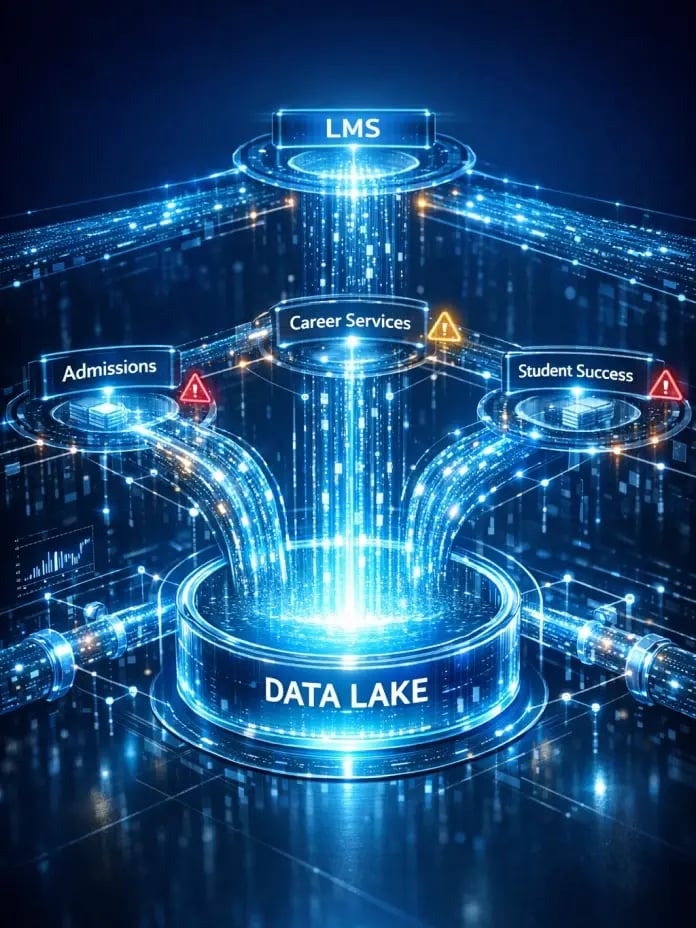
The average university operates across approximately 14 disconnected databases — a fragmentation that creates blind spots, duplicate errors, and delayed interventions. We consolidate SIS, LMS, and CRM into a single, real-time data lake, enabling every department from Admissions to Career Services to act on the same complete picture of the student journey.
- The Single Source of Truth — A unified data architecture eliminates the information silos that slow institutional decision-making, providing every stakeholder with a comprehensive, real-time portrait of each student's academic and personal trajectory.
- Cross-Departmental Workflow Automation — Intelligent triggers connect behavioral signals — such as a decline in meal plan usage or library activity — to automated alerts routed directly to the Student Success office, enabling holistic interventions that address root causes rather than academic symptoms.

Asset & Energy Optimization: Eliminate Ghost Rooms and Administrative Drag
Operational waste is silent but expensive. We apply IoT occupancy analytics and AI-driven process automation to recover the capacity and budget already embedded in your existing infrastructure — without new construction or additional headcount.
- Smart Campus IoT — Occupancy sensors and Wi-Fi triangulation reveal underutilized facilities operating at 20% capacity, enabling scheduling optimization that reduces energy and maintenance costs by 15–20% while deferring the capital expenditure of new construction.
- Administrative L5 Automation — High-friction processes like transfer credit evaluation — traditionally a 3-week manual review — are reduced to a 3-second AI-driven scan, accelerating administrative velocity and delivering instant credit-transfer estimates that measurably increase transfer enrollment conversion.
Measuring What Matters: The KPIs That Define Market Access Success
Skill-Match Percentage
The precise delta between the competencies taught in the curriculum and the specific requirements listed in regional job postings. A shrinking delta indicates high institutional agility.
Employee NPS (Net Promoter Score)
A rigorous measure of how likely a corporate partner is to hire from the same institution again, based on the performance and "day-one readiness" of previous graduates.
Accelerate NOW
your Growth & Innovation
Your growth journey starts with a conversation. Connect with our senior partners today to align our expertise in Business Model Innovation and Digital Transformation with your strategic topline priorities.