Know when your AI should hand over.
In one minute: why your AI agent leaves customers unhappy, and the rule that takes them from 85 to 12.
See the methodology Not ready to talk? Run the 2-minute simulator
Read the transcript1 min read +
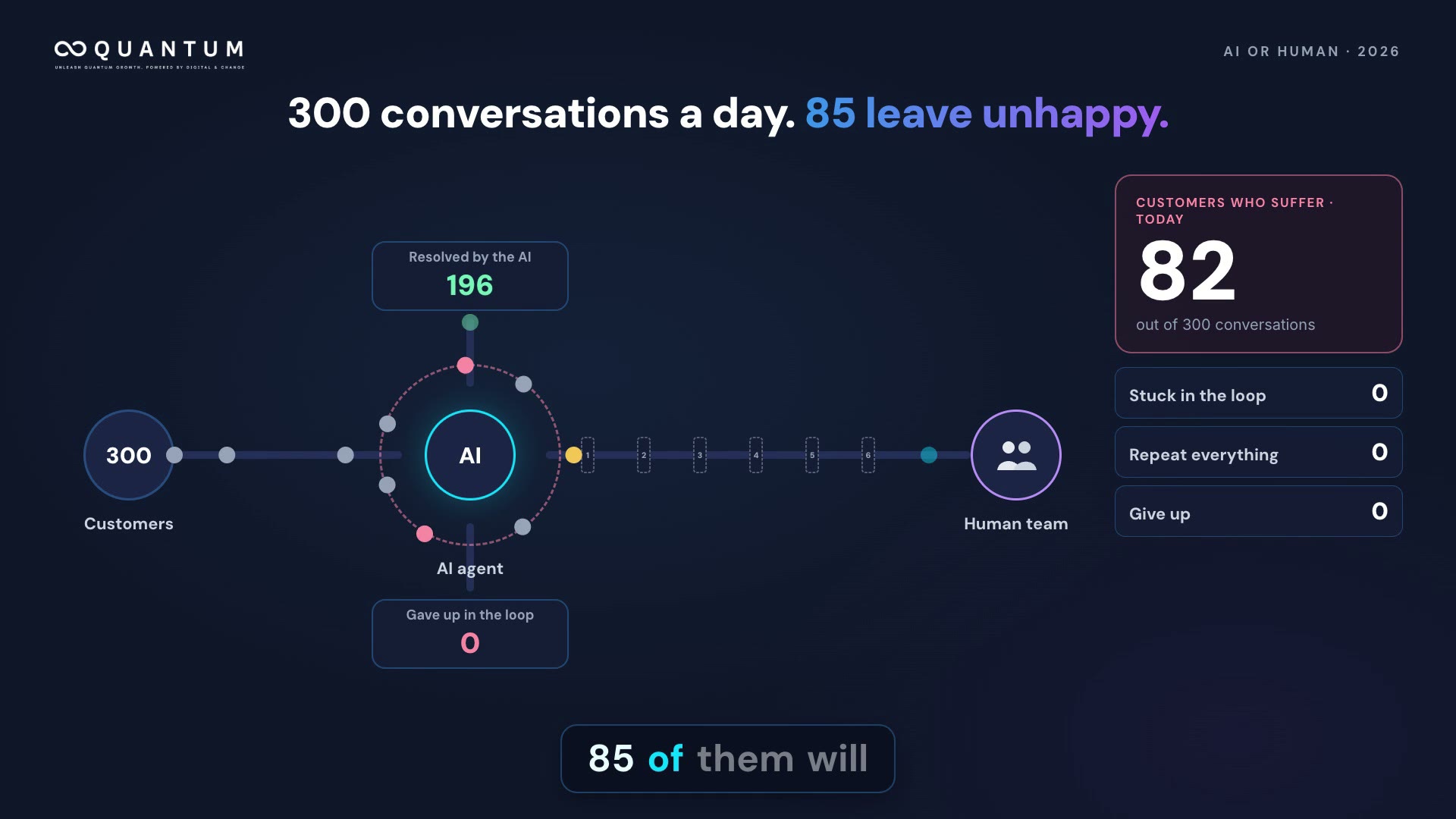
Three hundred customers talk to your AI agent today. Eighty-five of them will end the day unhappy.
Some ask for a human, and get one more try instead. Others go round in circles until they give up.
And when the AI finally hands over, forty-one have to start again from scratch. Your agent receives nothing.
The fix isn't a better bot. It's a handoff rule. Asks for a human, strong emotion, a sensitive topic: transfer now. Key accounts and complex cases: your call, written down. And a limit on failed attempts.
Every handoff comes with a summary, so nobody repeats themselves.
Same AI, same day: eighty-five unhappy customers become twelve. And the AI still resolves sixty-two percent on its own.
Let's write your handoff rule together. Pick thirty minutes that suit you.
AI voice · Captions onCredits
Music: “Marty Gots a Plan” — Kevin MacLeod (incompetech.com), licensed under Creative Commons: By Attribution 4.0. Voice: Chanon Asarisi (AI-cloned with consent).
- 87 %of customers say a human must be reachable when companies use GenAIGartner 2026
- 27 %would try a chatbot again after a negative experienceGartner 2026
- 74 %of consumers find it very frustrating to repeat themselvesZendesk CX Trends 2026
An AI without a handoff rule keeps the customers it should let go. That’s the problem.
of 300 customers end the day unhappy.
Some ask for a human and get one more try instead; others go round in circles until they give up. And 41 of those who finally reach a person have to start again from scratch.
unhappy customers — same AI, same day.
A request for a human, strong emotion or a sensitive topic triggers an immediate transfer, with a summary. And the AI still resolves 62 % of requests on its own.
Illustrative day, as in the video and the simulator: 300 customers talking to an AI agent. Run the simulator with your own volume and rules.
A handoff rule you can switch on — with or without us.
- 01
Where your AI keeps customers today
The loops, the retries and the requests for a human that go unanswered, read from your own conversations.
- 02
Your six criteria, written down
Four that transfer immediately — a request for a human, strong emotion, a sensitive topic, a limit on failed attempts — and the two that are your call: key accounts and complex cases.
- 03
The summary your agents receive
What the AI must pass on at every handoff, so nobody has to repeat themselves.
Built for the people who run AI in customer service.
- Customer service
Head of Customer Service
Keep the savings of your AI agent without the complaints that come with it.
- Digital & CX
CX or digital lead
Set the rule your chatbot or AI agent follows, and check it is applied.
- Orders & after-sales
Order management & after-sales
Make sure a delivery or billing dispute reaches a person before it becomes a lost account.
- Support operations
Head of Support Ops
Give your agents the context of every handoff, so they start where the AI stopped.
Let’s write your handoff rule together.
30 minutes with Chanon Asarisi, no commitment. You leave with your handoff rule, criterion by criterion.
- 0–10 minWhere your AI agent keeps customers today
- 10–20 minThe six criteria — and the two that are your call
- 20–30 minWhat your agents should receive at every handoff
- No commitment
- No slide deck
- You keep the plan
Run the 2-minute simulator
Your volume, your current handoff rules — and how many customers a day get stuck in the loop, give up or repeat everything.
Fair questions.
What is a handoff rule?
A short, written set of criteria that tells your AI agent when to pass a conversation to a person — and what it must hand over with it.
Won’t more handoffs cost us the savings of the AI?
In the illustrative day, the AI still resolves 62 % of requests on its own. The rule removes the conversations it should never have kept, not the ones it handles well.
Do we need a new AI tool?
No. We start from the AI agent or chatbot you already run. If it cannot apply a criterion, we tell you which one and why.
Our AI agent is still in pilot. Is it too early?
It’s the best moment: a handoff rule written before go-live is cheaper than one written after the first complaints.
Is this a sales call?
It’s a working session. You leave with a plan you can run on your own. If you want help putting it in place, we can talk about that separately.
Who is Quantum Growth Advisory?
A consultancy for customer service and sales teams, working on CRM, data and AI across HubSpot, Salesforce and Monday.
Meet your peers on November 25th in Paris.
One evening for customer service, CRM and commercial excellence leaders. Four workshops, including one on the KPIs that prove service performance (NPS, CSAT, resolution rate) — with or without AI.
- When
- Wednesday, November 25th · 6:30 pm – 9:30 pm
- Where
- Salons Hoche · 8 avenue Hoche, 75008 Paris
- Format
- 30 seats · 4 workshops · networking
- GartnerPress releases, August and September 2026 — 3,566 customers: access to a human with GenAI, trying a chatbot again after a bad experience
- ZendeskCX Trends 2026 — 11,000+ consumers and business leaders, 22 countries
- Illustrative exampleThe day shown in the video and the simulator: 300 customers, 85 unhappy without a rule, 12 with one. Not a client result.