Answer upset customers before they escalate.
In one minute: why your angriest customers wait like everyone else, and how to end escalations.
See the methodology Not ready to talk? Run the 2-minute simulator
Read the transcript1 min read +
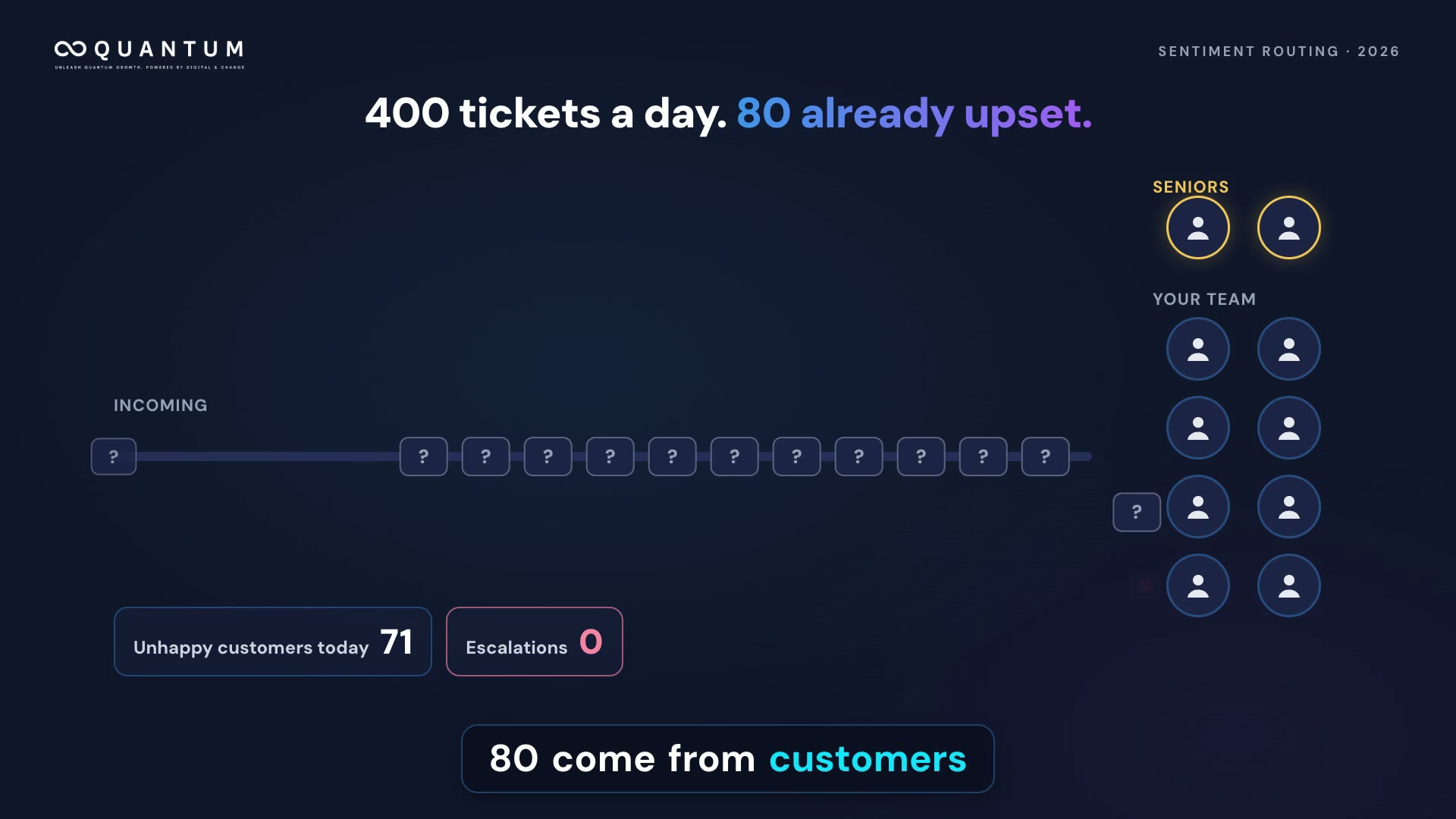
Four hundred tickets a day. Eighty come from customers who are already upset.
First come, first served: the angriest customer waits over an hour, like everyone else, and twelve a day escalate.
Eighty-three percent of customers expect to interact with someone immediately.
Read the tone and the account as each ticket arrives. Upset customers move to the front, and the most sensitive ones go to your seniors.
Same team: a first answer in twenty minutes instead of over an hour. Twelve escalations a day become zero.
Let's look at your queue together. Pick thirty minutes that suit you.
AI voice · Captions onCredits
Music: “Marty Gots a Plan” — Kevin MacLeod (incompetech.com), licensed under Creative Commons: By Attribution 4.0. Voice: Chanon Asarisi (AI-cloned with consent).
- 83 %of customers expect to interact with someone immediatelySalesforce Connected Customer 2022
- 12 %of customer experiences are rated badQualtrics XM Institute 2025
- 85 %of CX leaders say customers drop brands over unresolved issuesZendesk CX Trends 2026
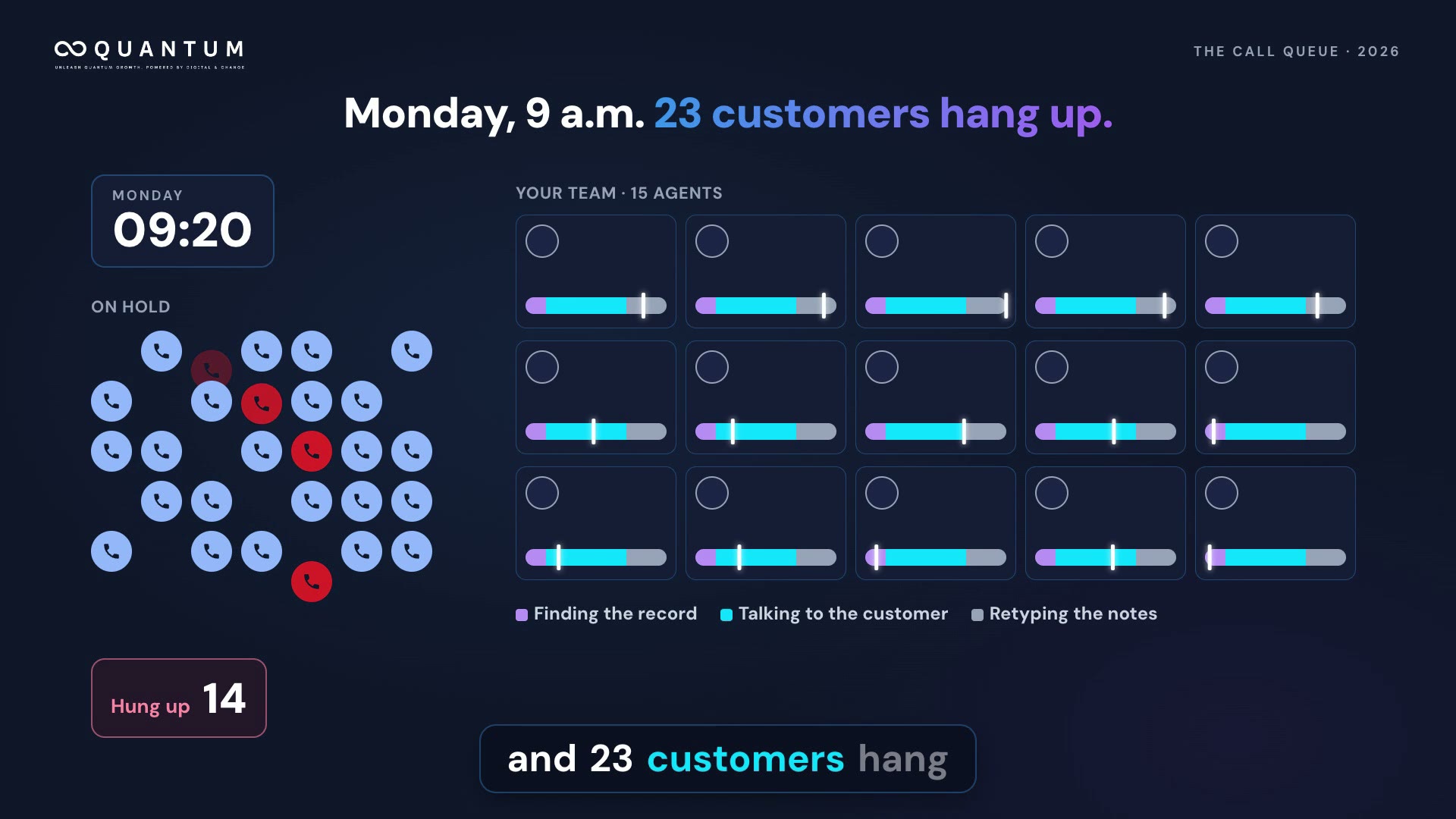
In most queues, an angry customer waits exactly as long as a routine question. That’s the problem.
escalations a day — the angriest wait over an hour.
400 tickets a day, 80 from customers who are already upset. In arrival order, they queue behind routine questions.
escalations a day — a first answer in 20 minutes.
Upset customers move to the front, and the most sensitive ones go to your seniors. Same team, same tickets: only the order changes.
Illustrative day, as in the video and the simulator: 400 tickets, 80 from upset customers. Run the simulator with your own volume and team.
A matrix your team can apply next week — with or without us.
- 01
How tickets are prioritised today
Who decides, on what, and where an upset customer waits in your queue.
- 02
The signals your tools already read
Tone, account value, history: which ones your helpdesk and CRM can use from day one.
- 03
Your routing matrix, rule by rule
A first-answer target for each combination of tone and account, and who handles what.
Built for the people who run the queue.
- Customer service
Head of Customer Service
Stop escalations at the source, before they reach your desk.
- Team leads
Team lead or supervisor
Give your seniors the cases that need them, automatically.
- Orders & after-sales
Order management & after-sales
Answer the customer whose delivery went wrong before they call again.
- Key accounts
Key account management
Make sure a strategic account never waits behind a routine question.
Let’s look at your queue together.
30 minutes with Chanon Asarisi, no commitment. You leave with a routing matrix your team can apply next week.
- 0–10 minHow tickets are prioritised today — and by whom
- 10–20 minThe signals your tools already read: tone, account, history
- 20–30 minYour routing matrix, rule by rule
- No commitment
- No slide deck
- You keep the plan
Run the 2-minute simulator
Your ticket volume, your team and seniors, the way you prioritise today — and how many escalations a day sentiment routing would avoid.
Fair questions.
What is sentiment routing?
Reading the tone of each ticket — and the account behind it — as it arrives, to decide its place in the queue and who should answer it.
Do we need a new helpdesk?
No. Most helpdesks and CRMs can already score tone or tag accounts. We start from what yours does today.
Won’t routine questions wait too long?
They wait a little longer, within a target you set. The matrix fixes a first-answer time for every combination, not just the urgent ones.
Is tone detection reliable enough?
It doesn’t need to be perfect: combined with account value and history, it only has to move the clearly upset customers forward.
Is this a sales call?
It’s a working session. You leave with a plan you can run on your own. If you want help putting it in place, we can talk about that separately.
Who is Quantum Growth Advisory?
A consultancy for customer service and sales teams, working on CRM, data and AI across HubSpot, Salesforce and Monday.
Meet your peers on November 25th in Paris.
One evening for customer service, CRM and commercial excellence leaders. Four workshops, including one on the KPIs that prove service performance (NPS, CSAT, resolution rate) — with or without AI.
- When
- Wednesday, November 25th · 6:30 pm – 9:30 pm
- Where
- Salons Hoche · 8 avenue Hoche, 75008 Paris
- Format
- 30 seats · 4 workshops · networking
- SalesforceState of the Connected Customer, 5th edition (2022) — 16,936 consumers and business buyers
- Qualtrics XM InstituteBad Experiences Across 20 Industries, 2025 — 23,730 consumers, 23 countries
- ZendeskCX Trends 2026 — 11,000+ consumers and business leaders, 22 countries
- Illustrative exampleThe day shown in the video and the simulator: 400 tickets, 12 escalations in arrival order, 0 with routing. Not a client result.