— Pillar article · Customer service · 2026 — Quantum Growth Advisory

The hidden costs of B2B customer service, and what agentic AI changes

Your customer service budget tracks headcount and volumes. What service really costs you shows up elsewhere: in contracts that don’t renew and in hours nobody sees.

The hidden costs of B2B customer service, and what agentic AI changes

01 — Why it matters

Why customer service costs more than its budget

Most B2B companies run customer service as a cost centre. They track headcount, ticket volume and first response time. Those numbers are useful, but they say nothing about what customer service makes you lose.

In B2B, every customer carries weight: a contract, several years of revenue, a sales cycle that took months. When a request drags on or an answer disappoints, the customer doesn’t always complain. They wait for the renewal date and don’t renew. Gartner puts it this way: a service interaction is nearly four times more likely to create disloyalty than loyalty.

Replacing that customer is expensive. According to the studies cited by Harvard Business Review, acquiring a new customer costs 5 to 25 times more than keeping an existing one. Bain & Company links a 5% increase in retention to a 25% to 95% increase in profits. The real cost of customer service shows up in revenue, not only in payroll.

02 — The 4 hidden costs

The 4 hidden costs of B2B customer service

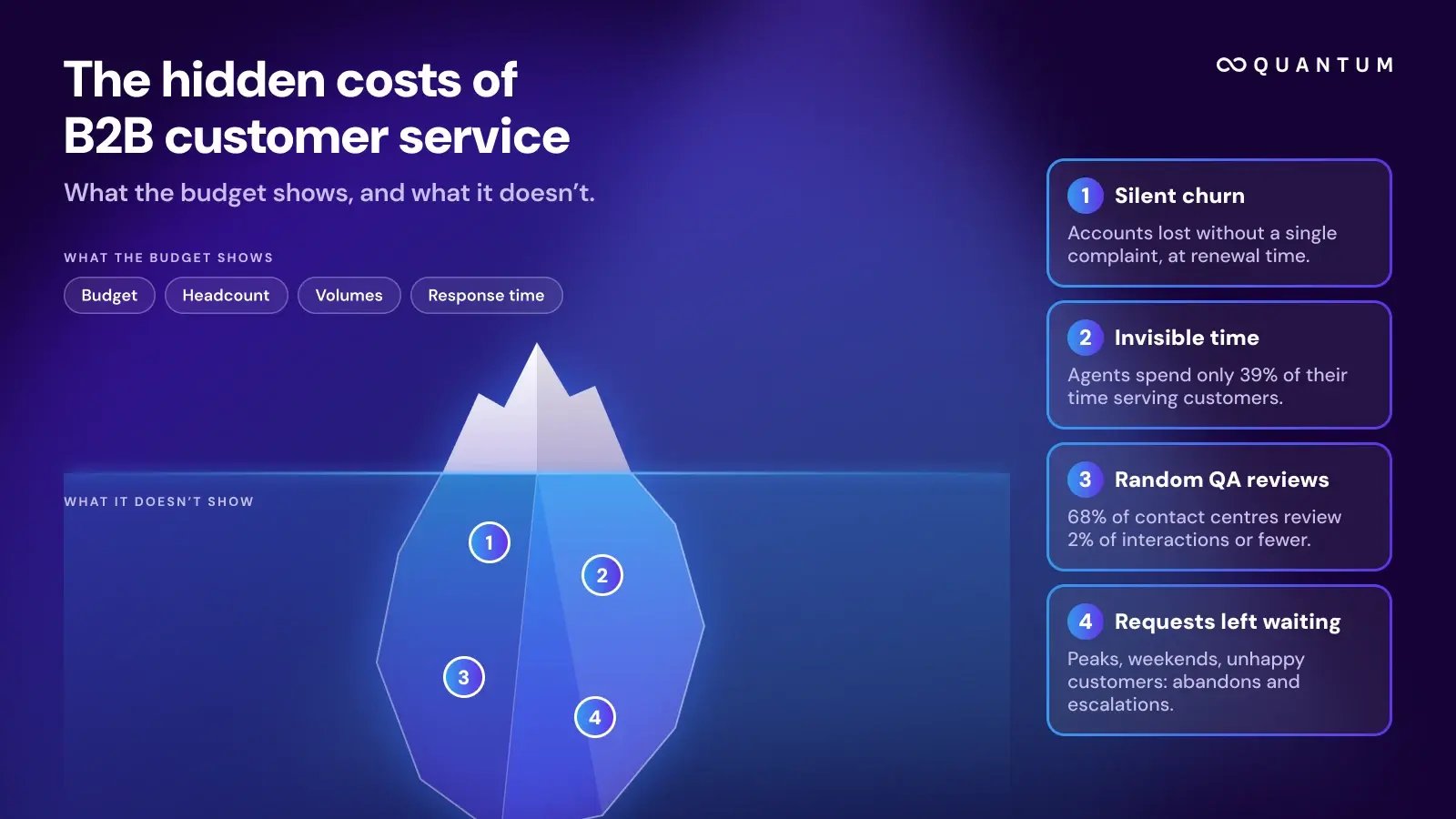
These four costs have one thing in common: none of them appears in the customer service budget. Yet each can be measured with data you already have.

1. Customers who leave without warning

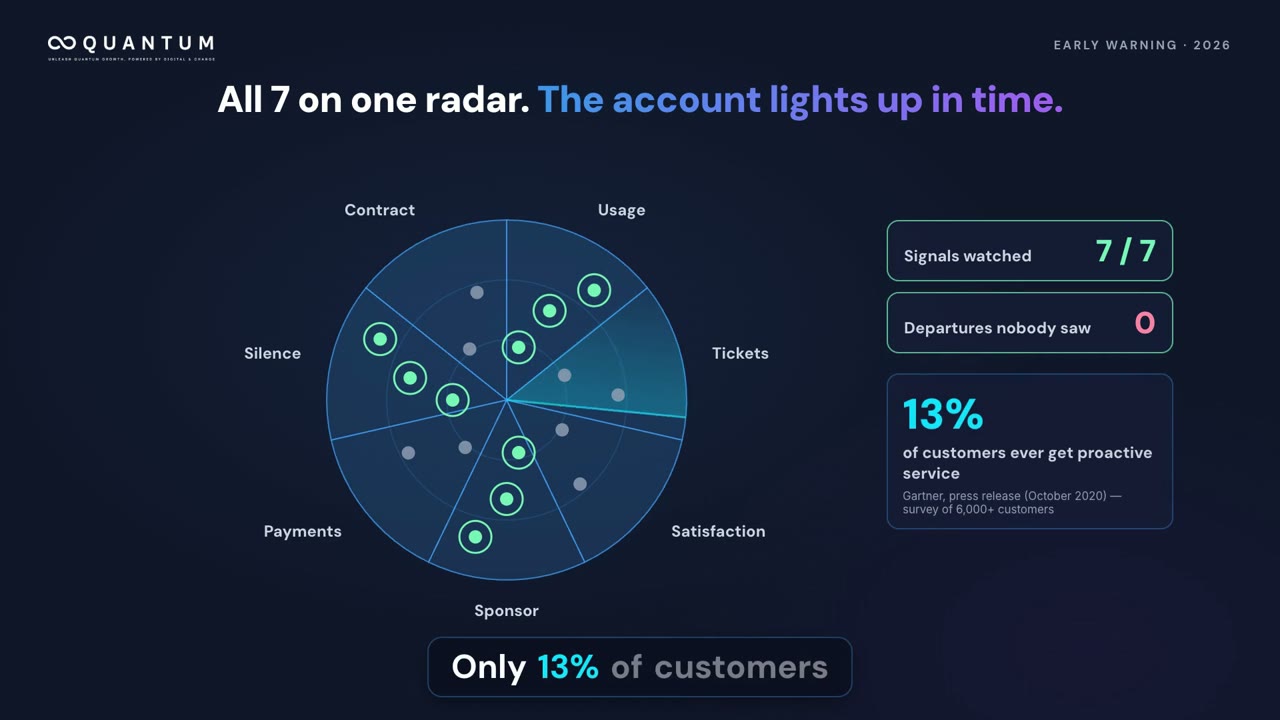
This is the heaviest cost and the least visible. An unhappy customer opens two tickets, waits, then lets the renewal date pass. No service metric turns red: the ticket is closed and the SLA was met. The signals are in your tools (reopened tickets, follow-ups, falling usage), but nobody connects them. Run the numbers with the silent churn simulator.

2. The time your customers never see

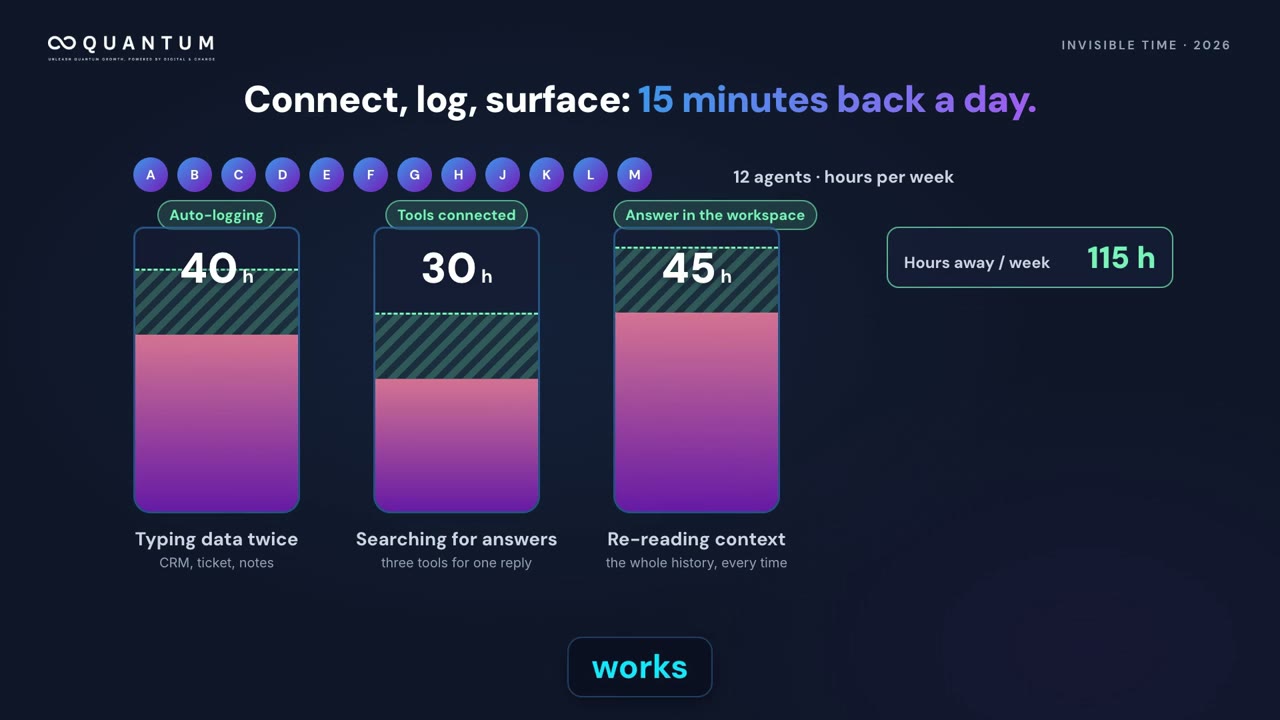
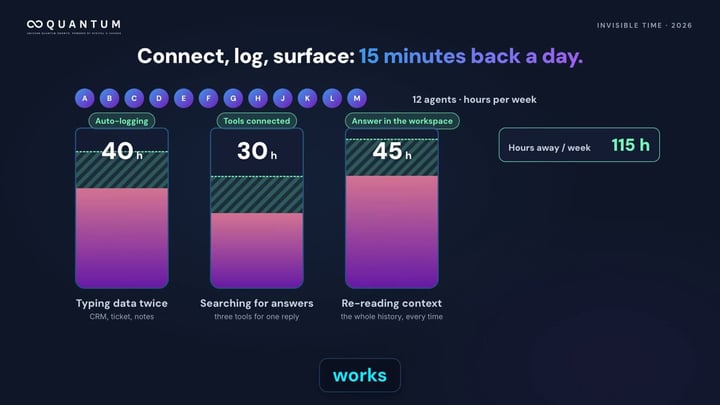
According to Salesforce’s State of Service survey (more than 5,500 service professionals, 2024), agents spend only 39% of their time serving customers. The rest goes to internal meetings, admin work and manually logging case notes. That time is paid for, but it appears in no customer metric. Measure it with the invisible time simulator.

3. QA reviews that look in the wrong place

Most quality teams score a random sample of conversations. In a Call Centre Helper poll, 68% of the contact centres surveyed evaluated 2% of their interactions or fewer. The conversations that lose a customer are rare, so a sample that small often misses them. You pay for reviews that confirm what works and miss what costs you. Test your sampling with the QA reviews simulator.

4. Requests left waiting

The Monday morning call peak, requests piling up over the weekend, an unhappy customer waiting in the same queue as everyone else: waiting doesn’t hit the budget, but it drives abandoned calls, follow-ups and escalation risk. See the Monday call peak, routing by customer sentiment and the weekend AI agent.

Table 1: The 4 hidden costs: what the budget shows, what it doesn’t, and how to measure them.
Hidden costWhat the budget showsWhat it doesn’t showHow to measure it
Silent churn Tickets closed within SLA Accounts lost after service incidents Non-renewals × annual value
Invisible time Headcount and volumes handled Hours spent outside conversations Hours × loaded hourly cost
Random QA reviews Average quality score At-risk conversations never reviewed Share of at-risk conversations reviewed
Requests left waiting Average response time Abandons, follow-ups, escalations Abandons × account value

03 — The role of agentic AI

What agentic AI changes for each cost

An AI agent doesn’t just answer: it acts in your tools. It can update a case, follow up with a customer or route a request. Gartner predicts that by 2029, agentic AI will resolve 80% of common customer service issues on its own, cutting operational costs by 30%. Across the four hidden costs, it acts in four places:

  • Silent churn: it connects scattered signals (reopened tickets, tone of conversations, falling usage) and alerts the account owner before the renewal date.
  • Invisible time: it writes case notes and conversation summaries, part of the work that fills the remaining 61% of agents’ time.
  • QA reviews: it analyses every conversation and flags the ones to review first, instead of a random sample.
  • Requests left waiting: it handles simple requests in the evening and at weekends, and moves unhappy customers to the front of the queue.

That gain disappears if the agent keeps a customer who needs a human for too long. Gartner also predicts that by 2027, half of the organisations that planned to cut their customer service workforce significantly thanks to AI will abandon those plans. So the useful question isn’t “do we need an AI agent?” but “when should it hand over?”. The AI handoff simulator helps you set that rule.

04 — Measure them in 5 steps

Measure your hidden costs in 5 steps

You don’t need a six-month project to put a number on these costs: the data is already in your CRM and your ticketing tool. Here is the method we follow with our clients.

  1. List the accounts you lost over 12 months

    For each one, check for reopened tickets, follow-ups or complaints in the six months before the renewal date.

  2. Measure time spent outside conversations

    Ask two or three agents to log their time for a week: conversations, data entry, meetings, searching for information.

  3. Check what your QA reviews cover

    Work out the share of conversations reviewed, then the share of at-risk conversations (unhappy customer, escalation) among them.

  4. Count the requests left waiting

    Calls abandoned at peak times, requests received outside business hours, wait time for unhappy customers.

  5. Convert to euros and prioritise

    Apply annual account value and loaded hourly cost, then tackle the largest cost first.

To go faster, our customer service ROI calculator estimates what your customer service costs today, in 8 questions. You can also discuss it with us at the Executive Conference on 25 November at Salons Hoche in Paris.
FAQ

Frequently asked questions

What is the hidden cost of customer service?

It is every cost the customer service budget doesn’t show: customers lost after a poor experience, agent time spent outside conversations, poorly targeted QA reviews and requests left waiting. In B2B, the first of these costs is counted in contracts, not hours.

How do you calculate the hidden cost of customer service?

Match your lost accounts against their ticket history, measure agent time spent outside conversations and count the requests left waiting. Convert each item to euros using annual account value and loaded hourly cost. The Lab’s ROI calculator gives a first estimate in 8 questions.

Can agentic AI reduce these costs?

Yes, mainly on repetitive work: case notes, simple requests outside business hours, analysis of every conversation. Gartner expects operational costs to fall by 30% by 2029. The gain depends on the handoff rule: an agent that keeps an unhappy customer too long can cost more than it saves.

Does it work with HubSpot and Salesforce?

Yes. HubSpot (Breeze) and Salesforce (Agentforce) both offer AI agents for customer service that run on CRM data. Their results depend on the quality of your ticket and account data, which is often the first thing to fix.

Verified data foundation

Sources & methodology

The figures in this article come from the public sources below, checked on 22 October 2026. The calculation methods are estimates to adapt to your own data. The Call Centre Helper poll dates from 2016 and covers 113 respondents: it gives an order of magnitude, not a recent measurement.

  1. [1] Gartner · Agentic AI Will Autonomously Resolve 80% of Common Customer Service Issues by 2029 — Press release, 5 March 2025
  2. [2] Gartner · 50% of Organizations Will Abandon Plans to Reduce Customer Service Workforce Due to AI — Press release, 10 June 2025 · 163 leaders surveyed
  3. [3] Gartner · Improve Customer Experience to Gain Loyalty (Effortless Experience)
  4. [4] Salesforce, via CX Today · State of Service, 6th edition — 5,500+ service professionals, 30 countries, 2024
  5. [5] Harvard Business Review · The Value of Keeping the Right Customers (Amy Gallo) — 29 October 2014
  6. [6] Call Centre Helper · Less than 2% of Interactions Evaluated for Quality Purposes — Poll, 113 respondents, 2016

Last fact-check : Oct 22, 2026

Newsletter · The Lab

Get our playbooks and field reports

Once a month: Salesforce, HubSpot, AI and B2B operations. No fluff.

Also worth reading in The Lab

Would you see your next lost account coming?

Would you see your next lost account coming?

October 20, 2026
See the next lost account while there is still time to act.

See the next lost account while there is still time to act.

October 20, 2026
How much of your team's time is invisible?

How much of your team's time is invisible?

October 20, 2026