— Recap · Dreamforce 2026 · Agentic AI — Quantum Growth Advisory
Dreamforce 2026: What It Means for Your Organization
Claudeforce, ready-to-hire agents, MCP and governance: the six Dreamforce 2026 takeaways that matter for a leadership team, and the questions to bring to your next leadership meeting.
Dreamforce 2026 ran from September 15 to 17. We followed more than forty sessions, and one idea runs through almost all of them: AI is moving from answering questions to acting inside your tools.
Until now, a sales rep would open an AI assistant, ask a question and get a generic answer. Then they'd go into the CRM to check, cross-reference and, above all, act. What was shown at Dreamforce removes that step: the AI reads your accounts, opportunities and history directly, and acts on them.
That's a real shift. But the sessions we learned the most from weren't about features. They were about governance, data quality, culture and measurement. New technology doesn't fix anything on its own, and that's the thread running through this recap.
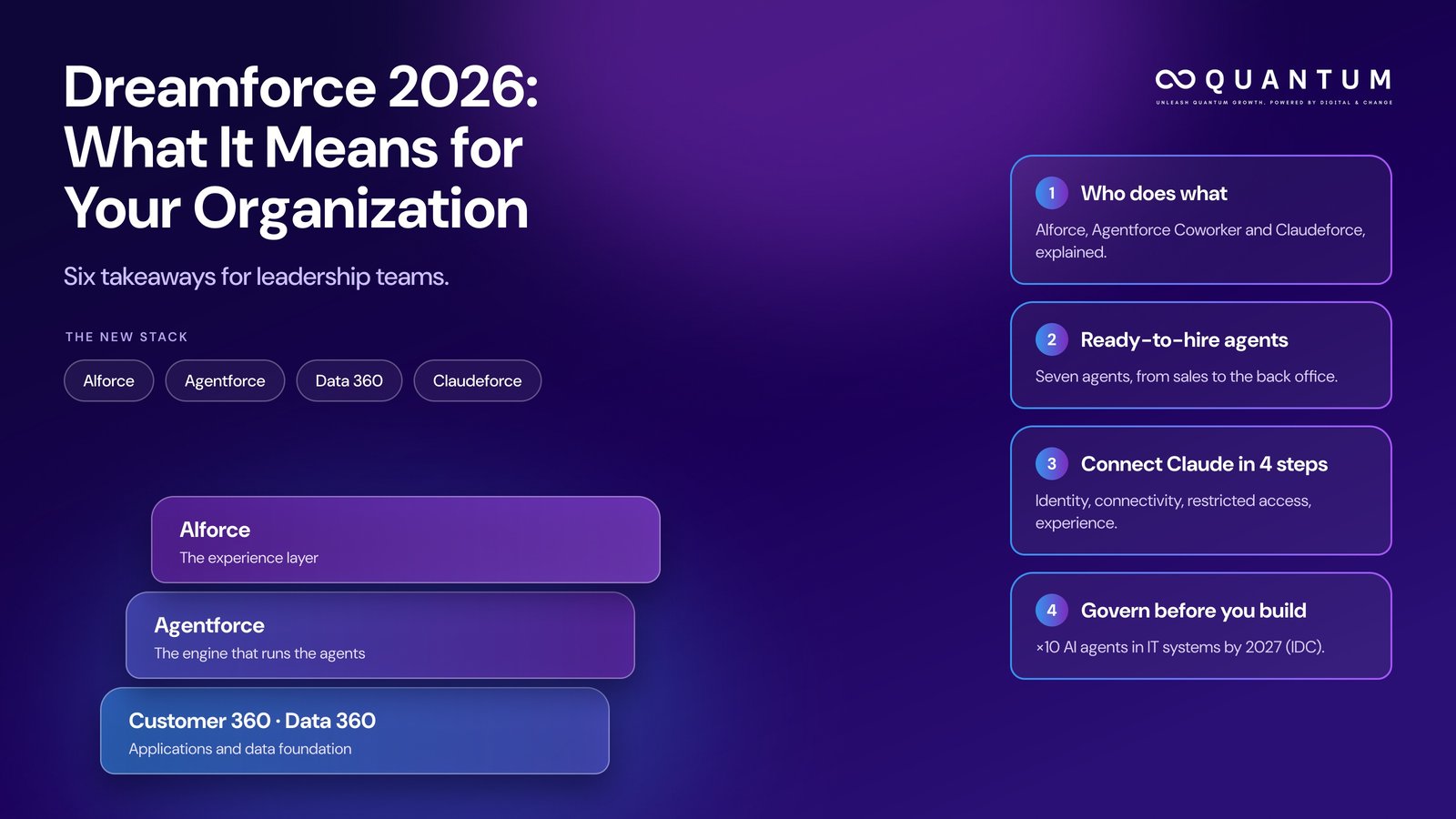
Three names keep coming up, and they don't mean the same thing. Here is the stack as it was presented in the keynote. AIforce is the experience layer: where you interact, whatever the interface. Agentforce is the engine that runs the agents. Customer 360 brings together the business applications, and Data 360 is the data foundation underneath.
On the Claudeforce side, 37 skills were announced as ready to use: morning briefing, account plan, call prep, flagging at-risk deals. Your CRM permissions apply as they are.
The line between "a Salesforce agent that uses Claude to reason" and "Claude connecting to Salesforce to act" takes a moment to grasp. Only one session all week, the one for architects, went into that technical detail. One question is enough to decide, though: in your organization, who should start the action, a Salesforce agent or a user starting from Claude? The answer tells you which of these products matters to you first.
Every keynote introduced a new AI "employee" with its own job description. Salesforce introduced this portfolio on September 11, in its official announcement of the new Agentforce lineup, then walked through it on stage.
Two numbers stood out to us. Casey claims more than 5 million cases already handled. And at Siemens, Marshall learned the supplier onboarding process in 90 minutes in a test environment, which cut onboarding from several days to a few hours, according to the demo shown at the opening keynote.
So don't treat these names as a gimmick. Each one maps to a job you already give to someone in your organization, or to software you configure yourself. The useful question isn't remembering them, it's knowing which one replaces an existing job and which one fills a gap.
Connecting an external AI to your CRM isn't a checkbox. The Architect Keynote broke it down into four decisions, in a specific order.
The server was in open beta, with general availability announced for early November 2026. The first three decisions don't need to wait for that date. We explain how this standard connection works in our article on MCP explained simply [LINK TO THE MCP ARTICLE ONCE PUBLISHED IN ENGLISH].
The Security Keynote asked a question few organizations can answer: how many AI agents went live in your systems this week, and who knows? An agent enters your tools without going through the checks you apply to a new hire. Three problems follow, named on stage: agents nobody sees, agents whose work nobody can reconstruct, and agents with too many rights.
To help you answer it, Salesforce announced three tools:
And no, governance doesn't necessarily slow you down. Capita, a UK services provider running more than 400 agents in production, explained that its governance sped up its pace of API innovation by 20%. Southwest Airlines shared its first principle: govern before you build, never after. We go deeper into these decisions in our article on agentic AI governance [LINK TO THE GOVERNANCE ARTICLE ONCE PUBLISHED IN ENGLISH].
It's tempting to think a new AI layer lets you start from scratch. But an agent doesn't invent anything: it executes what it finds. An opportunity stage that means three things depending on the team, a field with no owner, two sources of truth that contradict each other: it applies all of it, at its own speed. The stories we heard all point the same way:
- PenFed, a US credit union, shipped its first agent in under two weeks. It had first rationalized more than 400 applications onto a single foundation.
- Mastercard built its agent on a commercial source of truth in place since 2014, and rolled it out in stages: a trial, 100 users in production, then 1,000.
- Siemens: CEO Roland Busch said he did the opposite of his predecessors. Culture first, structure next, and only where it was truly blocking, AI last.
Before you open the tool, three questions tell you where you stand: who owns each field, which definitions differ from one team to another, and which source of truth is duplicated.
At the IT & HR Service Keynote, a McKinsey study cited on stage set the scene: 8 in 10 employees say AI makes them more productive, but fewer than 4 in 10 CFOs see it in the results. The demo that followed showed where the gap hides. An employee locked out of their account, 20 minutes before a meeting, gets an unrelated article, then a ticket with a two-day wait. They used AI, the dashboard will count it, but their problem isn't solved.
An MIT Sloan researcher, Renée Richardson Gosline, offered another lead: companies with the most mature experimentation practices see 30% more productivity gains than others. What drives results is how you test and learn, not the number of tools.
Finally, Pascal Bornet, author of "The Human-Agent Orchestrator," opened his session like this: you've already been promoted to manager, with no training and no raise. On a medical project, experienced analysts working with an agent handled up to 4 times more cases per day, while juniors had to stop at the first error. According to his research, 70% of management skills still apply with an agent, and 30% are specific to it.
The Dreamforce 2026 announcements make agentic AI accessible. What will make the difference in your organization is preparation: governance, data, measurement and support for your teams.
To be clear, we're not telling you to wait. The first three decisions for connecting an AI to your CRM, the list of your agents and the cleanup of your data definitions can all start now. It's what we remind every client of: a project isn't about handing over a task list and waiting for it to be done. You need someone who owns progress, risk and data. Four questions for your next leadership meeting:
If any of these questions goes unanswered, a 20-minute conversation is often enough to know where you stand. Book a meeting