Give your agents back the hours customers never see.
In one minute: where your agents’ hours go, and how to give 45 a week back to your customers.
See the methodology Not ready to talk? Run the 2-minute simulator
Read the transcript1 min read +
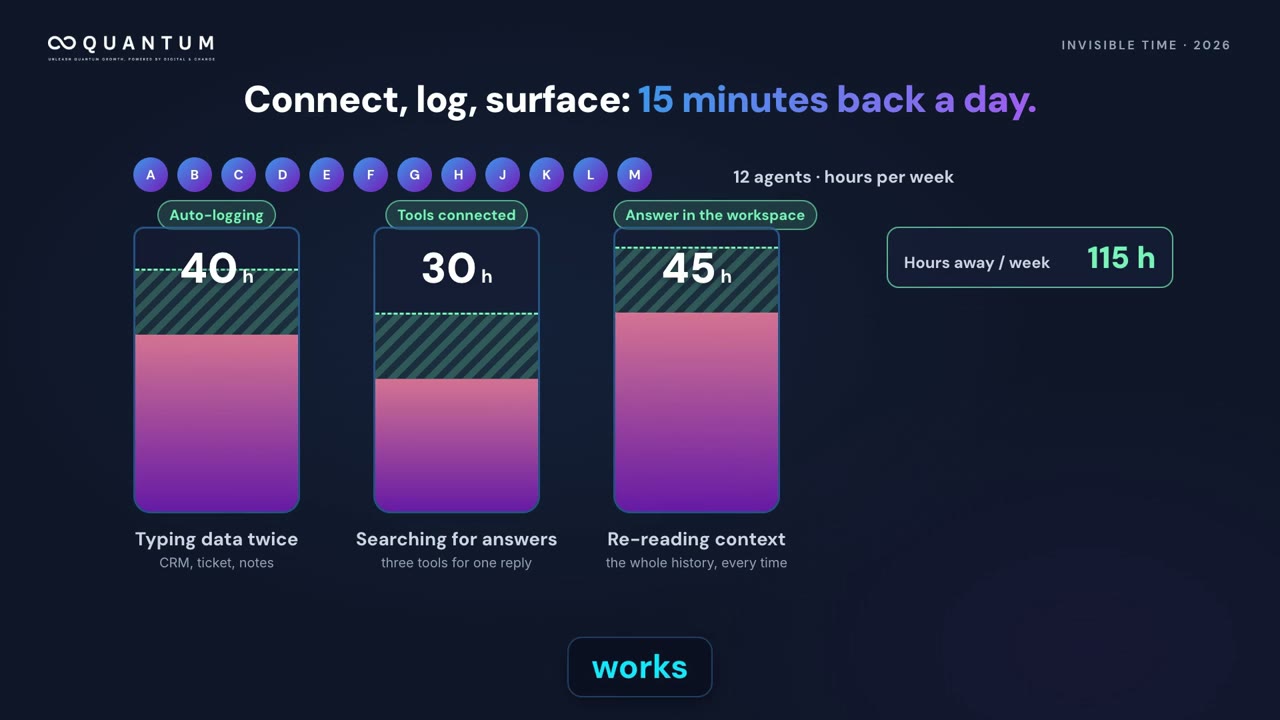
Twelve agents. A hundred and sixty hours a week, spent far from your customers.
Typing the same data twice. Searching three tools for one answer. Re-reading the whole history before every reply.
Across the market, service teams spend sixty-one percent of their time away from customers.
Connect the tools, log automatically, and put the answer where the agent already works. Fifteen minutes less a day, on each.
A hundred and sixty hours become a hundred and fifteen. Forty-five hours a week, back with your customers.
Let's find your hidden hours together. Choose a time that suits you.
AI voice · Captions onCredits
Music: “Marty Gots a Plan” — Kevin MacLeod (incompetech.com), licensed under Creative Commons: By Attribution 4.0. Voice: Chanon Asarisi (AI-cloned with consent).
- 61 %of service professionals’ time is spent away from customersSalesforce State of Service 2024
- 57 %of calls require gathering context first — 3.2 min eachVerint 2026
- 4separate tools for the average support professionalHubSpot 2024
Most of an agent’s week happens away from customers. That’s the problem.
a week spent away from customers, for 12 agents.
Double entry, searches across three tools, re-reading histories. Across the market, service teams spend 61 % of their time away from customers.
a week — 45 hours back with your customers.
Connect the tools, log automatically and put the answer where the agent already works: fifteen minutes less a day, on each.
Illustrative week, as in the video and the simulator: 12 agents. Run the simulator with your own team, tools and ways of working.
Hours you can win back this quarter — with or without us.
- 01
Where the week really goes
Your agents’ week rebuilt block by block, from market research and your own ways of working.
- 02
The two blocks to attack first
Double entry, searches or context checks: the ones your tools could remove soonest.
- 03
The metric that proves it
How to measure the hours won back, so leadership sees them.
Built for the people who run busy service teams.
- Customer service
Head of Customer Service
Absorb more volume with the same team, and show where the time went.
- Support operations
Head of Support Ops
Remove the steps your tools make agents repeat.
- Orders & after-sales
Order management & after-sales
Stop retyping orders and returns from one system to another.
- IT & tools
CRM or IT owner
Know which connection pays back first, in hours.
Let’s find your hidden hours together.
30 minutes with Chanon Asarisi, no commitment. You leave with the two blocks of invisible time to attack first, and the metric that makes each one visible.
- 0–10 minWhere your agents’ week really goes
- 10–20 minThe double entry, searches and context checks your tools could remove
- 20–30 minWhat to connect first — and how to measure the hours won back
- No commitment
- No slide deck
- You keep the plan
Run the 2-minute simulator
Your team size, tools and ways of working — your agents’ probable day rebuilt from market research, block by block.
Fair questions.
What is “invisible time”?
The work around each request that customers never see and dashboards rarely measure: double entry, searches, re-reading histories, switching tools.
Do we need new tools?
Usually not. Most of the gain comes from connecting the tools you already have and logging automatically.
How can you estimate our hours without our data?
The simulator rebuilds a probable week from market research and your answers. In the call, we check it against how your team really works.
Will this reduce headcount?
That’s your call. Most teams use the hours to absorb growth and spend more time with customers.
Is this a sales call?
It’s a working session. You leave with a plan you can run on your own. If you want help putting it in place, we can talk about that separately.
Who is Quantum Growth Advisory?
A consultancy for customer service and sales teams, working on CRM, data and AI across HubSpot, Salesforce and Monday.
Meet your peers on November 25th in Paris.
One evening for customer service, CRM and commercial excellence leaders. Four workshops, including one on the KPIs that prove service performance (NPS, CSAT, resolution rate) — with or without AI.
- When
- Wednesday, November 25th · 6:30 pm – 9:30 pm
- Where
- Salons Hoche · 8 avenue Hoche, 75008 Paris
- Format
- 30 seats · 4 workshops · networking
- SalesforceState of Service, 6th edition (2024) — 5,500+ service professionals, 30 countries
- VerintState of Agent Experience 2026 — 1,000 contact-centre agents
- HubSpotState of Service 2024 — 1,537 customer experience leaders
- Illustrative exampleThe week shown in the video and the simulator: 12 agents, 160 hours away from customers, 115 with tools connected. Not a client result.